
I’m driving the back way–down Wieuca, avoiding congested Roswell, and emerging near the Arby’s, where I’ll snag a shake with Reese’s peanut butter cup bits when I leave. Across Roswell, in about ten years, there will be a Starbucks popular with the cyclists and runners, and Saturday mornings will find a crowd of 40somethings in tight black spandex.
I’m wearing my first grown-up coat, purchased at Burlington coat factory. Since I’d stopped growing (which tbh happened in sixth grade), I could finally buy something “high quality that would last a long time.” Luckily, as usual, we found something high-quality that would last a long time for a cheap price thanks to Burlington.
It was my first brushed wool coat, long, to mid-calf, tapered at the waist, with slightly puffed sleeves, an 80s trend imitating a 1930s trend (explained to me by my drama teacher when I wore my new coat to school. He would be fired the following year for inappropriate behavior.) The 30s trend drew from the late 19th-, early 20th-century trend (think Mary Poppins), proceeded by the early 19th-century trend (mutton sleeves, like a leg of lamb), not to be outdone by the Tudor-era trend.
The color was a heathered dusty rose. I’d been color analyzed for my 16th birthday. I was a summer: cool tones with no oranges, blues and pinks, pure raspberry and iris. The most unflattering colors? All my favorites: warm, fall colors like rusts, olives, and oranges and extreme colors like black and white.

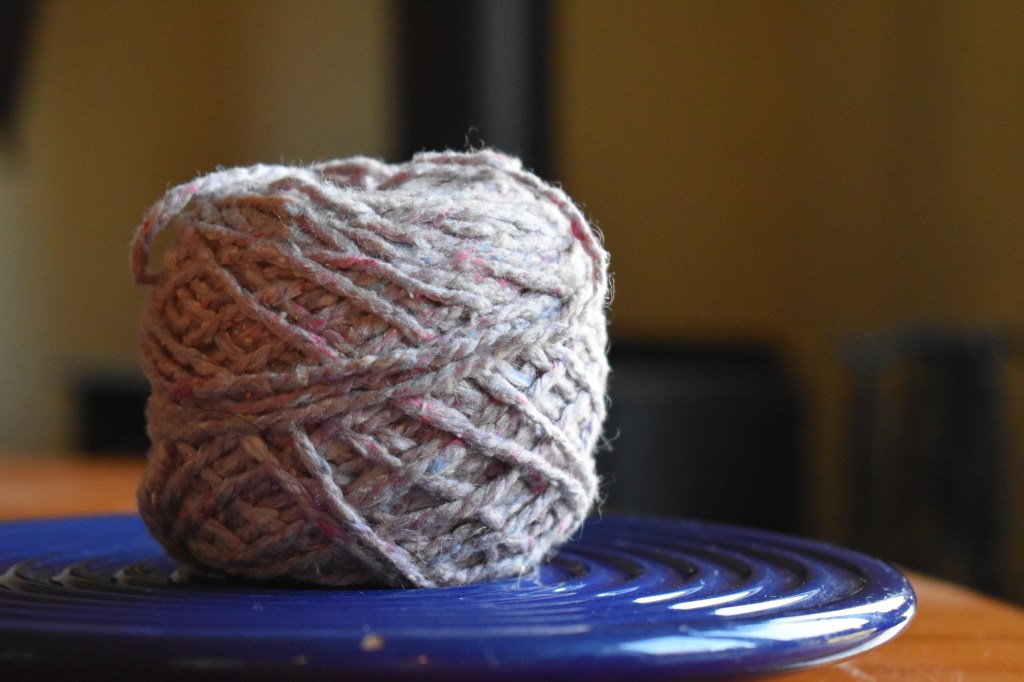
Anyway, I was learning to knit on some scrap yarn and was allowed to go to the yarn store to pick out a skein for real object to knit: a scarf. To match my coat and my color season, I choose the above.
After driving back home (Madonna’s Crazy for You came on the radio at some point–she’s maybe a summer, but looked fabulous in black, so maybe a winter), I believe my mom was skeptical about the yarn choice: too expensive with fibers too nice for a new knitter. But since I’d had them wind the skein. I couldn’t return it. I felt bad but not terrible, just a little embarrassed, a little wasteful.
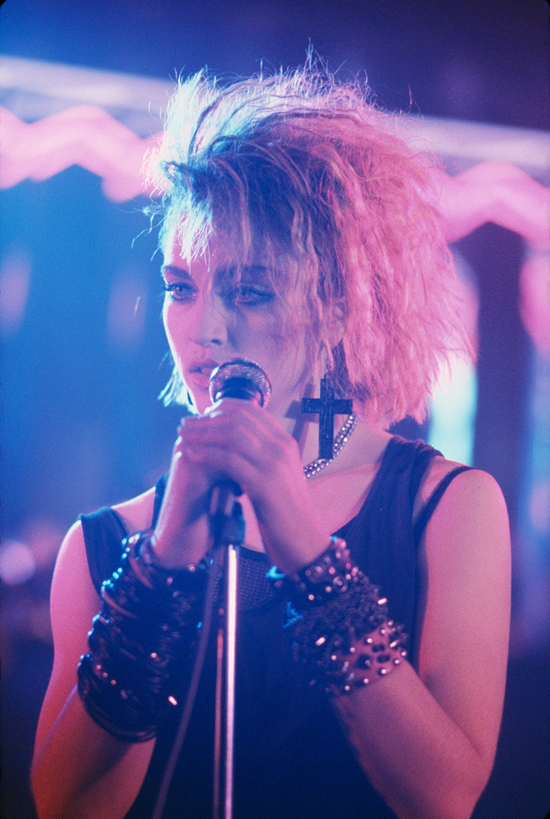
The general memory fits together like a triptych, but with different states of impressions capturing each panel of the story: visual–standing in the yarn store, facing north, looking down at the yarn in my hand, wood paneling and a warm taupe rug while twilight hit outside beyond Arby’s; auditory–hearing Madonna in the car, I’m crazy for you, baby; and feelings at the end of the story–this was a mistake. There’s no overlap. There are no feelings in the yarn store, I have no memory hearing what my mom said or what she looked like that night, I don’t know if Madonna played coming or going. Was I excited about buying the yarn? I have no memory. I’m only holding a skein. It’s like a memory pressed into the Matrix and layers are separate and flat.
That skein has remained a skein for a good long time. I must have lost interest or tried to earn the skill to use it or both. I don’t know. And I don’t remember deciding to carry it around with me for almost forty years but I have, only in the most passive and least conscious way possible. I think it’s just been in the depths of a bag–I tend to keep containers of all sizes. About half is missing. I have a slight awareness that I used some for a tiny hat for one of my nieces when she was a baby, but it’s an oddly disjointed thought, like someone else’s memory.
But in my recent full-throttle obsession with knitting, I came upon it, picked it up. and thought, “what the hell? How did you make it this far?” I became fully conscious of its presence and odd beginning with the same jolt when it occurred to me in adulthood that my older siblings weren’t chewing their tongues as they claimed those times I asked what they had in their mouths. It was gum and they just didn’t want to share.
I couldn’t believe I had this yarn from long ago. I touched the pink softness. I thought of our attic in Atlanta.
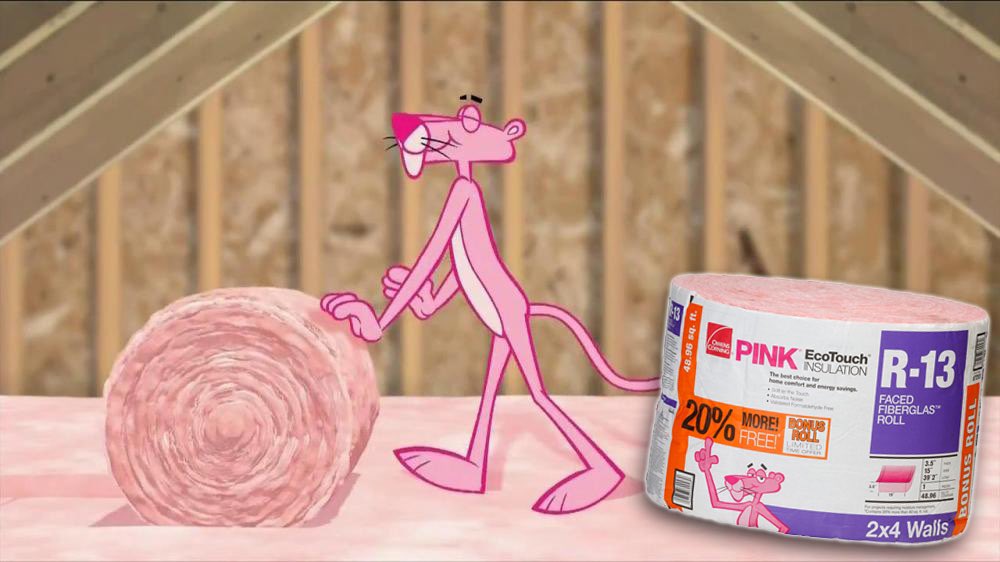
We played almost regularly in the unfinished space, which ran the length of our house–mostly pretending Little House on the Prairie with thick skirts covered in as many aprons as possible. The back area floor and walls converged in an A-frame and were uncovered, fluffy-looking Pink Panther fiberglass insulation bare between the studs. Adults warned us not to not touch because of the bits of glass that made up the material. Of course we’d touch it, on purpose or by accident or both, washing our hands later in a panic, imagining it in our skin, tiny glass slivers doing something painful and hurtful or at least insidious.
As an adult, I’ve read that breathing it in is more problematic than touching it, your body prompting coughing and sneezing to expel it from upper airways. If it makes it as far as the lower lungs, the irritation and inflammation are more dangerous, with evolving bronchitis-like symptoms, and eventual scarring. But from what I’ve read, unlike asbestos, there’s no link to cancer unless other substances are added to the glass to strengthen it, like aluminum oxide.
Asbestos, on the other hand, is a toxic mineral, occurring naturally (glass is not a mineral; rather, it’s an amalgam that contains the mineral silicate, and is a ceramic.) Asbestos is an adept insulator too but extremely carcinogenic. Why? Because when it makes its way into the deeper levels of our bodies and causes, like bits of glass do, inflammation and scarring, it’s the kind of inflammation and irritation that can reach into cellular DNA and damage it, changing the instructions in our cells, causing new cells to follow a twisted version of evolution and go rogue; basically, that’s cancer.
These different insulations are a lot like memories, some a little prickly buy also warm, some damaging and harmful, perhaps of acts done in the guise of love, but misguided and injurious, even deadly.
The memories in this skein of yarn are prickly but warm, wound into a neat little nonreturnable ball, hidden shards that aren’t really so bad. Apparently, I must carry it until my skills are worthy, until I pull the sword from the stone, until I take the red pill instead of the blue and learn some truth. That’s a lot of pressure for a ball of yarn.
I think of my friends who, like most of us, have glass shards embedded in memories; they’re warm but cautious. Some have an inlay of asbestos and sometimes the inflammation disrupts their days, their DNA showing degrees of alteration. But I’m frequently amazed at their capacity for joy, their responsibility toward life, and their ability to seek adventure.
But I’m still left with this partial skein that I’ve carried so long. I don’t know what to make of it. A pot holder? A mitten? Maybe I’ll keep it like this, wound and ready, a bit of potential, a mistake that can still become something else.
***
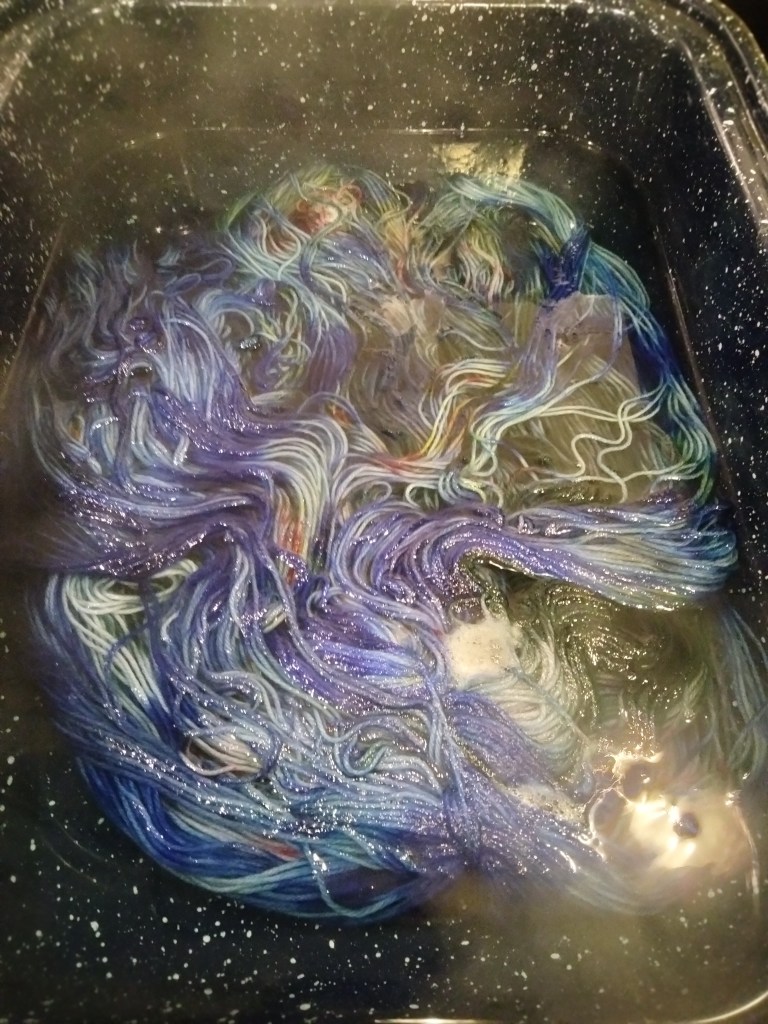
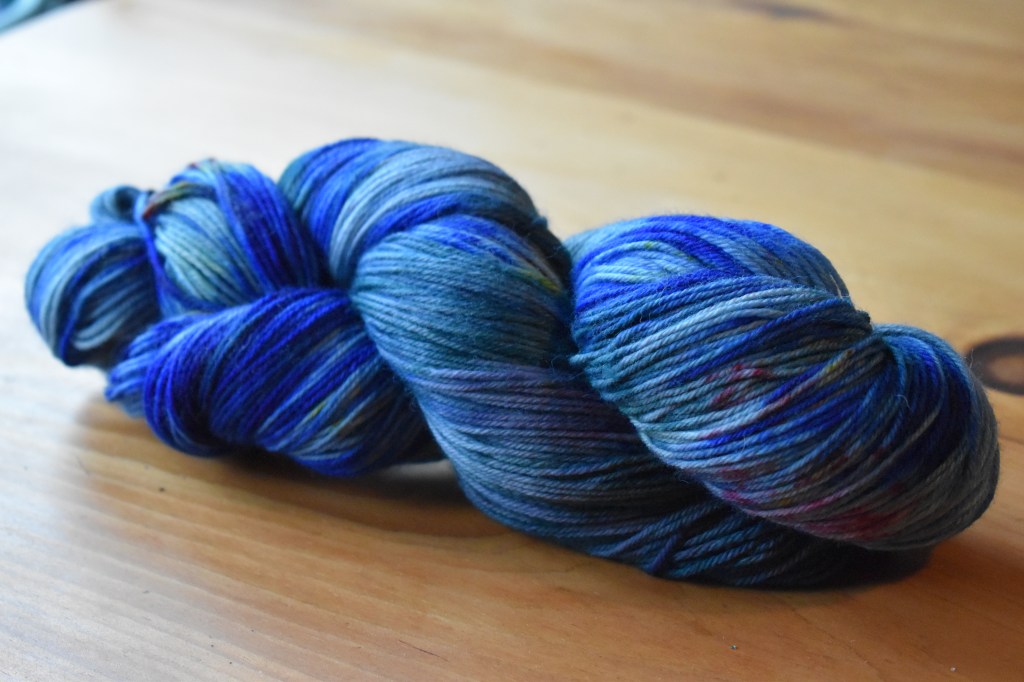
Speaking of which, I’ve played again in our basement as Grandpa Munster mixing colors and came up with this skein in an attempt to create a variegated blue for the small version of Ishbel for one of my sisters. The problem is, I’ve also seen a gorgeous tonal blue skein at our local yarn shop (LYS), Spun, one of the best shops around, which is half-a-mile from my house. That skein is maybe a little too expensive, maybe made from fibers just a little too luxurious, or maybe not.



 Casting Threads
Leave a comment